Can AI help develop a sophisticated financial platform, complete with interactive dashboards, card controls, savings calculators, and animations? I built FORMA to explore what that process could look like.
AI website development has changed considerably in 2026.
We’re moving beyond generating basic landing pages and experimenting with tools that can help develop entire interactive experiences.
But there’s an important difference between creating a website that looks functional and building a product that actually works.
I wanted to explore that distinction through FORMA, an independent fintech concept combining a complete visual identity, three-page website, financial dashboards, payment card controls, and savings planning tools.
The result is an interactive experience that demonstrates how AI-assisted development can help translate complex product ideas into working prototypes.
1. Why AI Website Development Is Becoming More Interesting
For years, website development followed a relatively predictable workflow.
A business would commission a design, review static mockups, approve the visual direction, and then move into development.
This approach still makes sense for many projects.
But it introduces an interesting limitation.
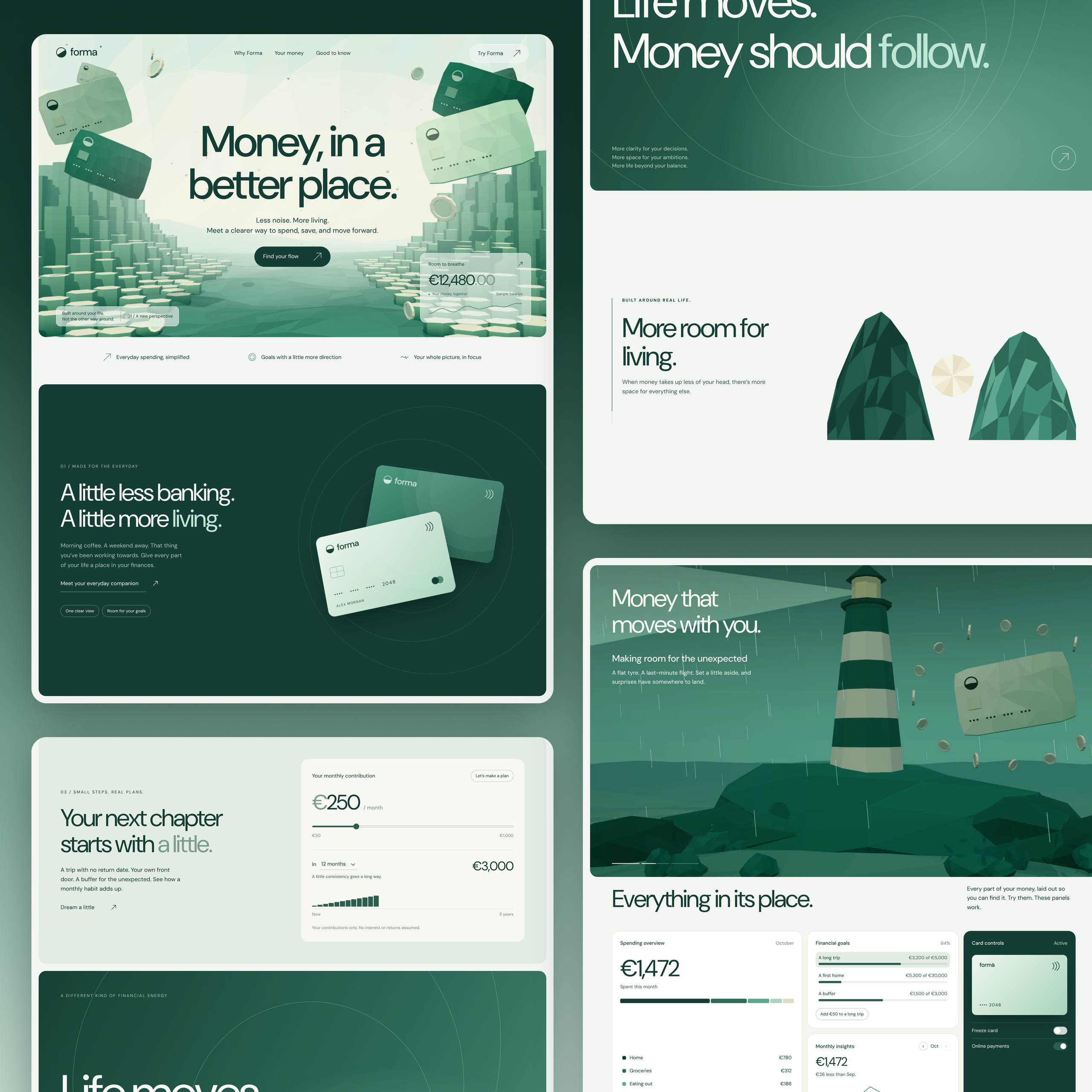
A design can look excellent in Figma while leaving important questions about functionality unanswered.
How will a dashboard respond when someone changes the date range? What happens when a customer adjusts a financial goal? How should a payment card communicate that it’s been frozen?
You can describe these interactions in documentation, but it’s considerably easier to evaluate them when you can use them.
Modern AI tools can help shorten the distance between an idea and a working demonstration.
Instead of waiting until the entire design process is completed, teams can develop interactive components, test different approaches, and refine the experience earlier.
That doesn’t eliminate the need for planning or engineering.
It changes when people can begin testing their assumptions.
2. The FORMA Fintech Website Example
FORMA is a fictional financial service platform designed around the idea that managing money should feel simpler and more approachable.
I developed the concept around three connected experiences.
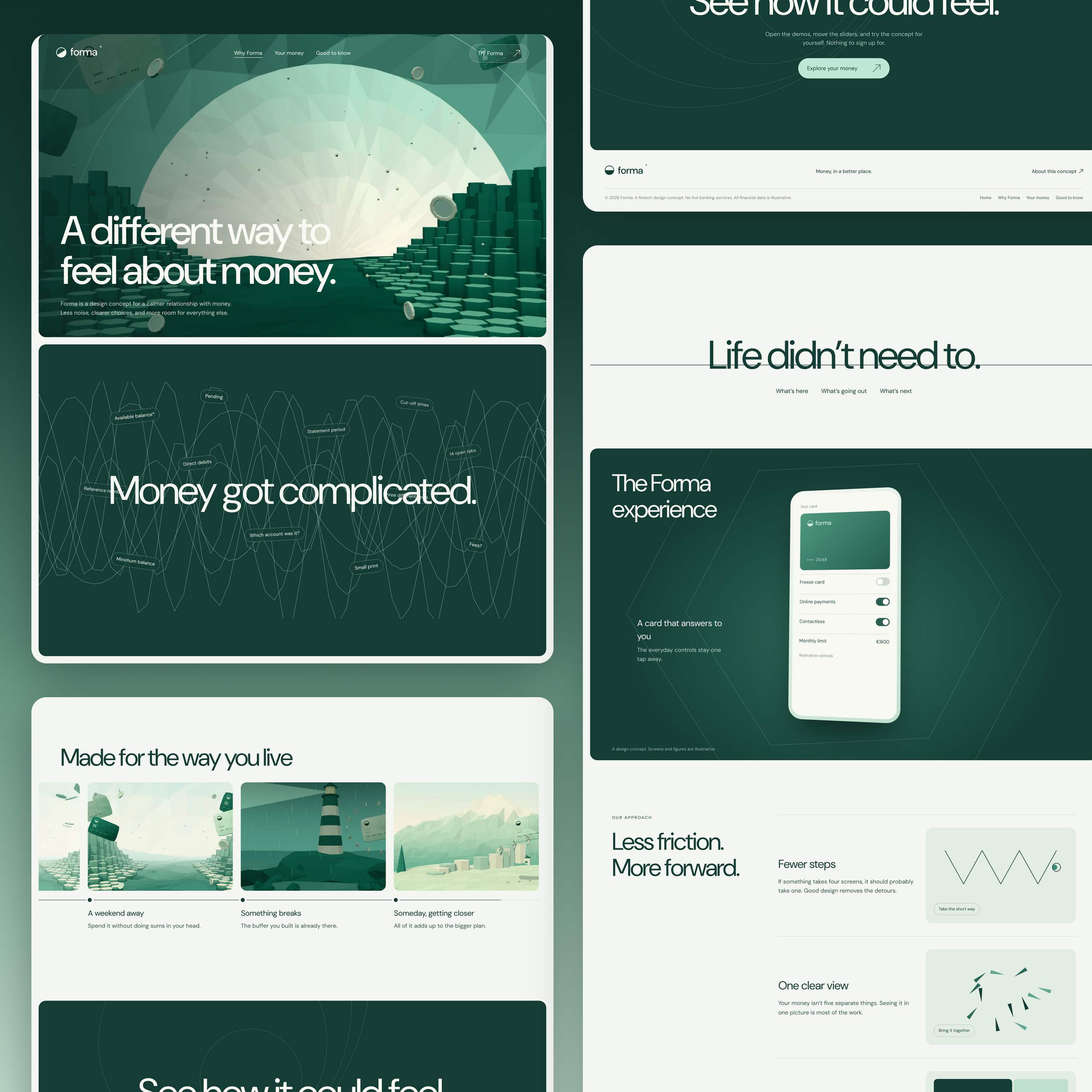
Home: A marketing page introducing the brand through familiar financial situations, animations, and interactive product demonstrations.
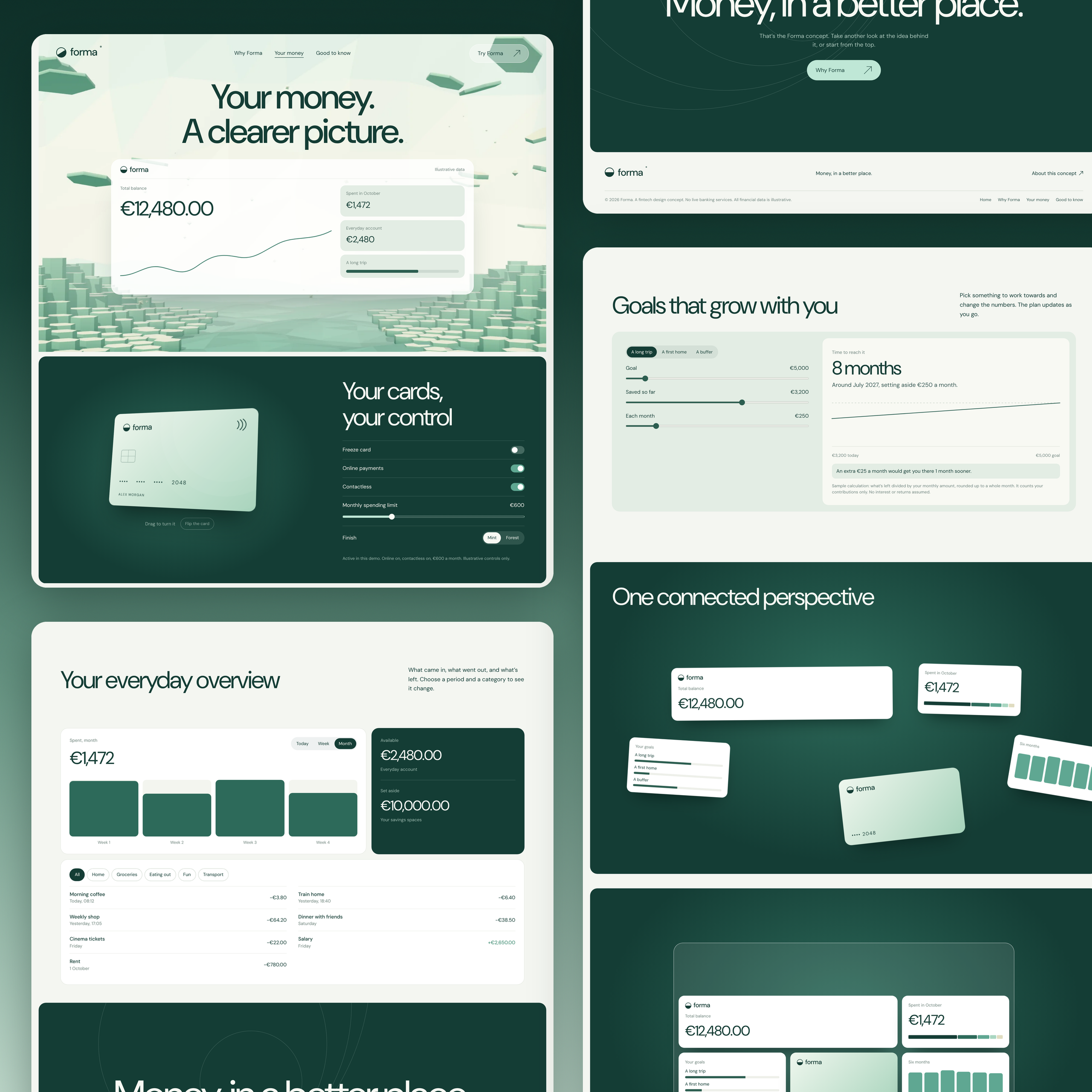
Why Forma: A page explaining the product’s approach to everyday financial management.
Your Money: An interactive financial interface featuring spending analytics, transaction filtering, card management, and savings tools.
The objective wasn’t to create another generic website with financial terminology.
I wanted visitors to understand what the proposed product could do by actually interacting with it.
This makes FORMA a useful example of AI-assisted website development because the experience includes several different kinds of functionality, each with its own interface requirements.
3. Building Interactive Financial Applications With AI
One of the most useful applications of AI in software development is helping translate clearly defined requirements into functional interfaces.
But the requirements still need to make sense.
For FORMA, the financial dashboard needed to answer basic questions.
How much money is available? Where is it going? What transactions occurred recently? How close is someone to a savings goal?
Those questions informed the information hierarchy.
The dashboard presents the overview first, with additional controls for exploring different spending periods and transaction categories.
AI-assisted development can accelerate the implementation of these components, including layout variations, state management, interactive filters, and calculations.
However, the design still needs to be evaluated against the original business requirements.
A dashboard containing more charts isn’t necessarily more useful.
The objective is to make financial information easier to interpret.
Payment Card Interactions
The payment card demonstration introduces another type of interface.
Visitors can switch between visual finishes, flip the card, freeze it, adjust payment settings, and change spending limits.
These interactions use simulated states rather than live payment systems.
But they demonstrate how product teams could explore a proposed card-management workflow before connecting it to real financial infrastructure.
The key is ensuring that each control has a clear purpose and provides understandable feedback.
Savings Planning
The savings calculator allows visitors to select a goal, adjust their target amount, change monthly contributions, and see an updated completion timeline.
This is where interactive prototypes become particularly useful.
Stakeholders can evaluate the calculation logic, explore different scenarios, and understand whether the results are presented clearly.
The FORMA calculator uses illustrative values and doesn’t assume interest or investment returns.
A production financial application would need more extensive validation of its assumptions and calculations.
4. AI-Assisted Development vs. AI-Powered Fintech
There’s an important distinction worth making.
Using AI to develop a fintech website is not the same as building AI into a fintech product.
The first concerns the development process.
The second concerns the actual functionality delivered to customers.
AI-powered fintech solutions might involve fraud detection, predictive analytics, financial data analysis, risk management, or AI personalization.
Some financial services companies also use AI chatbots for customer support or machine learning models to evaluate information.
These AI use cases introduce their own requirements around data infrastructure, model development, regulatory compliance, security, and monitoring.
FORMA doesn’t implement those capabilities.
It uses interactive demonstrations to explore the interface of a proposed financial product.
That’s a useful starting point, but it shouldn’t be confused with a production AI platform or an operational banking application.
For fintech startups, understanding that distinction can prevent expensive misunderstandings about development scope.
5. Why Prototyping Matters Before Production Development
One of the biggest advantages of developing interactive prototypes is the ability to identify problems before building the underlying infrastructure.
Consider the payment card controls.
It’s relatively straightforward to demonstrate a card-freezing interaction visually.
But connecting that control to an actual payment system introduces additional questions.
What happens if the request fails?
Does the interface wait for confirmation?
How is the user notified?
What happens if the card is frozen from another device?
Does the action require additional authentication?
These are questions that development teams need to resolve before deployment.
An early prototype won’t answer all of them, but it can reveal where decisions are missing.
The same applies to financial analytics, account information, and savings calculations.
A working demonstration can help teams evaluate user journeys, test interface assumptions, and prepare clearer requirements for production.
The business benefit isn’t simply faster design. It’s discovering what needs to be built before committing to the full development cost.
6. Compliance, Security, and the Limits of AI
Financial applications operate under requirements that ordinary marketing websites may never encounter.
Depending on the service and jurisdiction, these can include identity verification, secure authentication, banking integrations, audit trails, data handling requirements, and financial regulations.
Regulatory compliance isn’t something an AI website generator can guarantee.
Neither is application security.
A real financial platform may handle sensitive data, connect to external banking services, or process information that must be protected under specific rules.
Those responsibilities require appropriate architecture, testing, engineering, and specialist oversight.
For example, a production system may need to maintain an audit trail of sensitive account actions and handle real-time data from external providers.
The interface must also distinguish between a pending action and a completed one.
AI can assist with development tasks, testing, documentation, and code reviews, but the output needs independent verification.
For a successful fintech implementation, the best practice is to define security, compliance requirements, and data integration responsibilities before production development begins.
FORMA is deliberately a demonstration environment, not a financial system connected to real customer accounts.
7. When Should Businesses Use AI for Website Development?
Not every business needs an interactive financial platform.
For a straightforward company website, a conventional CMS or AI-assisted website builder may be entirely sufficient.
The more interesting use cases emerge when the business needs custom interactions.
For example:
- A SaaS company demonstrating complex product functionality.
- A fintech startup testing an account dashboard before developing its backend.
- A B2B platform creating an interactive product demonstration for prospective customers.
- An established business exploring a website redesign.
- A startup preparing a working prototype for investor presentations.
In each case, AI can help accelerate parts of the development workflow.
But the right approach depends on the intended business outcomes.
A prototype designed to communicate an idea has different requirements from a production application serving thousands of customers.
The goal should be to use the technology where it provides a genuine advantage, rather than making AI part of the project simply because it’s available.
8. What AI Still Needs From People
The best AI development tools can generate useful interfaces and assist with increasingly complicated tasks.
But they don’t automatically understand the business behind the website.
They don’t know which features customers actually need, whether the interface communicates the correct information, or whether a particular interaction makes commercial sense.
That work still requires judgment.
For FORMA, the important design decisions concerned the product structure, visual identity, financial information, and relationships between the website and the proposed application.
AI-assisted implementation can help turn those decisions into working experiences.
It doesn’t replace the decisions themselves.
This is particularly important when building complex financial products, where an attractive interface can still communicate the wrong thing.
9. What Businesses Can Learn From FORMA
The most interesting outcome of FORMA isn’t that an interactive financial website can be created with AI assistance.
It’s that businesses can explore sophisticated digital experiences before committing to full-scale product development.
A founder can demonstrate an idea to potential investors.
A product team can review how the interface behaves.
A development company can use an interactive prototype to define implementation requirements.
And a business owner can explore different design directions without relying entirely on static presentations.
The same approach can be applied beyond the fintech industry, particularly to SaaS products, complex service platforms, and businesses developing custom digital tools.
The objective is to make ideas testable earlier, while keeping the distinction between a prototype and a production-ready application clear.
10. Explore the FORMA Project
FORMA is an independent fintech brand and interactive website concept featuring a three-page website, financial dashboards, payment card controls, savings tools, and motion design.
The concept is currently available for acquisition for $12,000, with the final assets and transfer terms agreed upon separately.
It isn’t a functioning bank or a production-ready financial application.
Explore the working FORMA concept
For a closer look at the branding and interface decisions, see the FORMA design case study on BBDirector.
And if you’re considering AI-assisted website development for your own business, the useful starting point isn’t deciding which AI model to use.
It’s defining what you’re trying to build, who needs to use it, and what the experience needs to accomplish.
The tools come after that.
Related Reading
If you’re exploring AI website development for your own business, these practical guides go further into the tools, workflows, and decisions involved.
- How I Built an Interactive Website Concept With ChatGPT and Claude Code in Under 30 Minutes. A real project demonstrating how AI can accelerate early website prototyping.
- How to Use AI to Build an Agritech Website System. A complete workflow covering website strategy, visual design, prompting, development, and deployment.
- AI Website Audit: An Evidence-Based Worksheet. How to evaluate an existing website’s content, structure, usability, and technical evidence.
- AI Brand Guidelines: A Template Your Team Can Use. How to maintain brand consistency when using AI for creative and development work.
- AI Prompt Library: A Reusable System for Small Teams. How to turn successful AI instructions into repeatable, reviewable processes.
FORMA is an independent design concept. It doesn’t provide banking services or process real financial transactions. The interfaces use illustrative information.