
Ask AI to create an agritech logo and you will usually get the usual suspects.
A leaf.
A field.
A sun.
A green gradient.
Maybe a small data node somewhere, because apparently every agriculture technology logo needs to prove it has opened a dashboard at least once.
That is not the real problem.
The real problem is not that SMEs cannot generate logo ideas anymore.
The real problem is that most SMEs do not know what the logo should actually communicate.
That matters a lot in agritech.
Because an agritech logo is not just supposed to look green, natural, or modern. It is supposed to communicate trust, agriculture, technology, practicality, innovation, credibility, and future growth before anyone reads the website, pitch deck, or company profile.
That is a lot of pressure for one small mark.
So this article is not about using AI to replace a designer.
It is about using AI to prepare better before working with one.
Because the better you understand your company, market, audience, and visual direction, the better your brand identity becomes.
AI is not useful only because it can generate things.
It is useful because it can help SMEs ask better questions before money gets spent.
And in logo design, better questions usually lead to better outcomes.
Why Agritech Logos Are Difficult
Agritech sits between two very different worlds.
One world is agriculture.
That means land, crops, food systems, soil, farmers, machinery, weather, field conditions, sustainability, environmental pressure, and real-world implementation.
The other world is technology.
That means data, software, dashboards, robotics, sensors, automation, artificial intelligence, digital platforms, engineering, research, and scalable systems.
An agritech logo has to make those two worlds feel connected.
If the logo leans too far into agriculture, the company may look like a traditional farm, food producer, or organic product brand.
If the logo leans too far into technology, the company may look like a generic SaaS startup that accidentally found itself in a cornfield.
The best agritech identities usually sit in the middle.
Agricultural, but not rustic.
Technological, but not cold.
Sustainable, but not generic.
Professional, but not lifeless.
Modern, but still connected to the field.
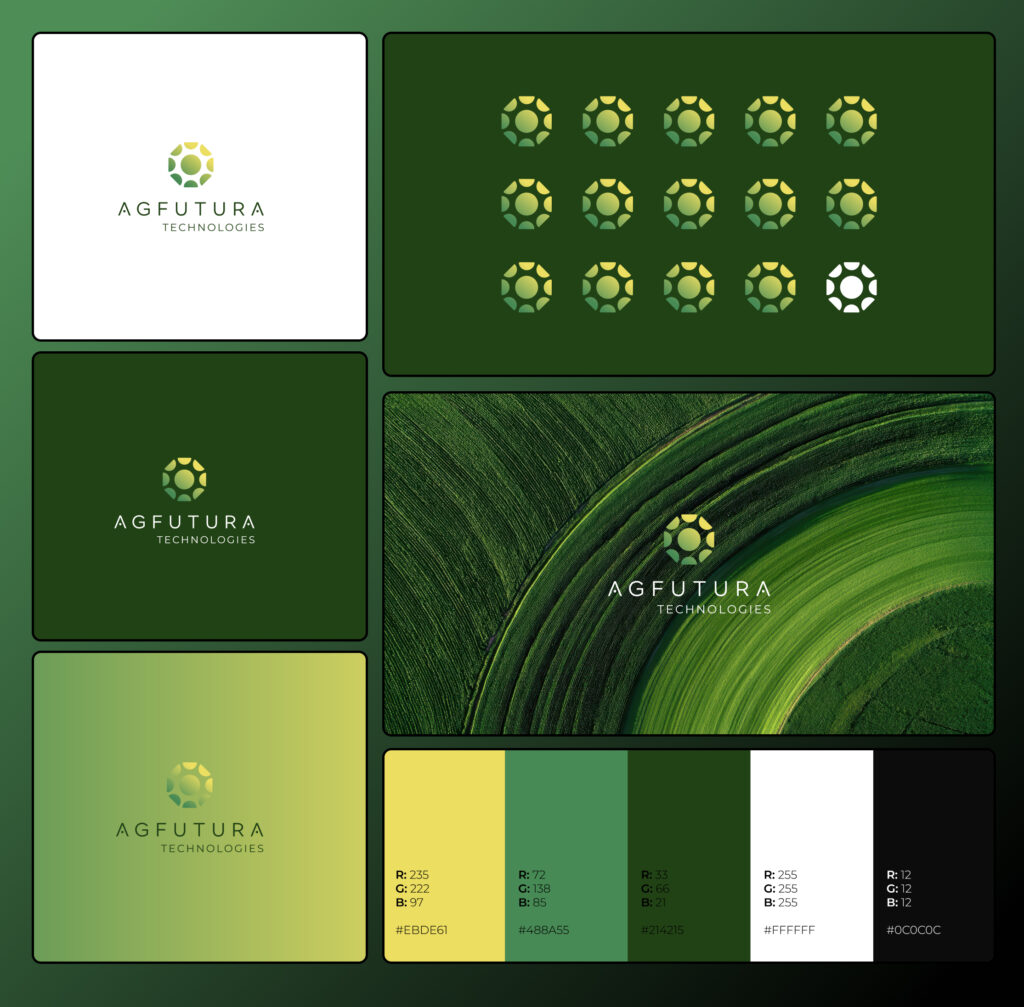
That is the balance.
And that is exactly where AI can help SMEs think through the brand before design starts.
Use AI to Decide What the Logo Should Communicate
Most people jump straight to this prompt:
“Create a logo for my agritech company.”
That is too vague.
A better starting point is:
“What should our logo make people understand about us?”
Before visuals, you need clarity on:
What kind of agritech company are we?
Who needs to trust us?
What should people feel when they see us?
What visual clichés should we avoid?
Where will this logo appear?
How technical should the brand feel?
How agricultural should it feel?
How institutional should it feel?
How scalable does the identity need to be?
These answers become the logo strategy.
The logo itself comes later.
Think of AI as a strategy assistant that helps you prepare the brief.
Not as a magical logo factory.
Magical logo factories usually produce magical garbage.
Very shiny. Very fast. Very useless.
Prompt 1: Define What Kind of Agritech Company You Are
The first step is to stop using “agritech” as a vague label.
Agritech can mean a lot of different things.
A farm management app is not the same as an agricultural robotics company.
A soil intelligence platform is not the same as a food systems consultancy.
A drone mapping company is not the same as a company working on EU innovation projects.
So ask AI to help you define the exact category.
Act as a brand strategist for agritech SMEs.

Help me define the specific category of this company.

Company description:
[Paste your company description]

Services or products:
[Paste services/products]

Target customers:
[Paste target customers]

Please identify:

1. The specific agritech category we belong to
2. What type of company we should not be confused with
3. The main business value we provide
4. The most important audience we need to build trust with
5. The words people might use to describe our category
6. The visual direction this category usually suggests
7. The visual clichés we should avoid
This prompt helps you get out of the vague “we are innovative in agriculture” swamp.
Because the more specific the category, the better the logo brief becomes.
A logo for a precision agriculture platform should not feel the same as a logo for a regenerative soil consultancy.
One may need to communicate accuracy, control, data, and intelligence.
The other may need to communicate restoration, ecology, trust, and long-term stewardship.
Same broad industry.
Different visual signals.
Prompt 2: Identify the Trust Problem
Every logo has a trust problem to solve.
That sounds dramatic, but it is true.
People look at your logo and quickly decide what kind of company they think you are.
In agritech, trust is complicated because your audience may include farmers, public institutions, investors, researchers, engineers, food producers, universities, EU project partners, government bodies, or technology teams.
Each group looks for different signals.
Farmers may want practicality.
Investors may want scale.
Institutions may want credibility.
Researchers may want seriousness.
Business partners may want clarity.
Technology partners may want capability.
Your logo cannot explain everything, but it can support the right first impression.
Use this prompt:
Act as a brand strategist and market positioning advisor.

For this agritech company, identify the trust signals the logo and visual identity need to communicate.

Company:
[Paste company description]

Audience groups:
[Paste audience groups]

Please define:

1. What each audience needs to trust
2. What visual signals would help create that trust
3. What visual signals would damage trust
4. Whether the brand should feel more agricultural, more technological, or balanced
5. Whether the identity should feel more institutional, commercial, startup-like, or field-focused
6. The top 5 words the logo should make people think of
7. The top 5 words the logo should avoid making people think of
This is where AI starts becoming useful.
Not because it designs the mark.
Because it helps you understand the business pressure behind the mark.
A logo for an agritech SME is not just “something nice for the website.”
It is a shortcut for trust.
And if that shortcut points in the wrong direction, everything else becomes harder.
Prompt 3: Find the Visual Tension
Good logos often solve a tension.
Agritech brands are full of tension.
Nature vs technology.
Fieldwork vs data.
Research vs implementation.
Sustainability vs commercial growth.
Local trust vs global scale.
Traditional agriculture vs future systems.
Public-sector credibility vs startup momentum.
Instead of ignoring this tension, use it.
That tension can become the core of the identity.
Act as a senior brand identity strategist.

Identify the main visual tensions in this agritech brand.

Company:
[Paste company description]

What we do:
[Paste services/products]

Target audiences:
[Paste audience groups]

Please identify:

1. The top 3 strategic tensions in the brand
2. Why each tension matters
3. How each tension could be expressed visually
4. Which tension is strongest for the logo
5. What the logo should balance
6. What would happen if the logo leans too far to one side
For example, the main tension might be agriculture vs technology.
That means the logo may need natural references but structured geometry.
Or maybe the tension is research vs implementation.
That means the logo may need to feel credible and systematic, but also practical and field-connected.
Or maybe the tension is sustainability vs commercial growth.
That means the logo should avoid looking like a charity or eco-lifestyle brand and instead communicate measurable, scalable environmental value.
This is how AI helps you turn “I want it to look modern” into something useful.
Because “modern” alone is not a strategy.
It is just a word clients use when they are trying not to say “I hate this.”
Prompt 4: Choose What the Logo Should Show
A logo should not try to show everything.
That is how you end up with a leaf, a sun, a globe, a circuit board, a water drop, a tractor, and a handshake trapped inside one poor little icon.
A logo should compress meaning.
It should not collect symbols like souvenirs.
So use AI to choose the main idea.
Act as a logo strategy consultant.

Based on this agritech company, recommend the strongest symbolic directions for the logo.

Company:
[Paste company description]

Brand goals:
[Paste goals]

Audience:
[Paste audience]

Please suggest 8 possible symbolic territories.

For each one, include:

1. Symbolic territory name
2. What it communicates
3. Why it fits this company
4. What visual forms could express it
5. What type of audience it would appeal to
6. What risk it creates
7. Whether it feels more agricultural, technological, institutional, or balanced
Possible symbolic territories might include:
Growth systems.
Field intelligence.
Circular ecosystems.
Data in nature.
Applied innovation.
Precision and yield.
Connected agriculture.
Research to field.
These are much better than “green logo.”
They help you think.
And thinking is still annoyingly important.
Even with AI.
Prompt 5: Avoid the Generic Leaf Trap
Let’s talk about the leaf.
The leaf is not evil.
The leaf has done nothing wrong except be overworked by thousands of designers, founders, pitch decks, sustainability consultants, and organic soap brands.
A leaf can work.
But it needs a reason.
If the leaf is only there because the company has something to do with agriculture, it is probably too shallow.
Use this prompt to pressure-test the idea.
Act as a critical brand reviewer.

Review this agritech logo idea:

Logo idea:
[Describe the logo idea]

Company:
[Paste company description]

Please tell me:

1. Does this idea feel too generic?
2. Does it rely on obvious agriculture clichés?
3. Does it communicate technology or only nature?
4. Does it communicate the company’s specific role?
5. Could another agritech company use the same idea?
6. What would make the concept more ownable?
7. What should be removed or simplified?
8. What stronger alternatives should we consider?
This prompt is useful because most early logo ideas sound better in your head than they look in the market.
AI can help you test whether the idea is specific enough.
Not perfect.
Specific.
That is the standard.
A logo does not need to explain your full business plan.
But it should not look like it belongs to everyone else either.
Prompt 6: Build the Logo Brief for a Designer
This is probably the most practical use for SMEs.
Use AI to create a better logo brief.
Not a Pinterest moodboard with “clean, modern, premium, fresh” written under 14 unrelated images.
A real brief.
Something a designer can actually use.
Act as a senior creative director.

Create a logo design brief for an agritech SME.

Company:
[Paste company description]

Audience:
[Paste audience groups]

Brand goals:
[Paste goals]

What the logo should communicate:
[Paste key ideas]

Please create a clear logo brief with:

1. Business context
2. Target audience
3. Strategic goal of the logo
4. What the logo should communicate
5. What the logo should avoid
6. Preferred visual territories
7. Color direction
8. Typography direction
9. Usage contexts
10. Practical requirements
11. Examples of logos or styles to avoid
12. Questions the designer should answer
This is where AI becomes genuinely useful for SMEs.
A better brief leads to better work.
And even if you are not a designer, you can still use AI to become clearer about what you need.
That alone can save weeks of confusion.
Or at least three meetings where someone says “Can it pop more?” and everyone pretends that means something.
Prompt 7: Test the Logo Before You Approve It
Once you have logo concepts, use AI to evaluate them strategically.
This does not replace human judgment.
But it can help you ask better questions.
You can describe the logo or upload the image into a visual AI tool and ask for a critique.
Act as a brand identity reviewer for agritech companies.

Evaluate this logo concept for strategic fit.

Company:
[Paste company description]

Target audiences:
[Paste audience groups]

Logo description:
[Describe the logo or upload image if your AI tool supports images]

Please evaluate:

1. Does the logo communicate agriculture?
2. Does it communicate technology?
3. Does it feel credible for institutional partners?
4. Does it feel practical for field-related audiences?
5. Does it avoid generic eco-brand clichés?
6. Does it feel scalable across digital and print?
7. What first impression does it create?
8. What might be misunderstood?
9. What should be improved?
10. Should this direction be refined, rejected, or expanded?
This prompt helps you move beyond:
“I like it.”
“I don’t like it.”
“My cousin said the icon looks like a kiwi.”
Useful feedback needs criteria.
AI can help create that criteria.
Example: Thinking Through an Agritech Logo Like AGFUTURA Technologies
Let’s use an AGFUTURA-style example.
Imagine an agritech and applied innovation company working across agriculture, engineering, digital systems, sustainability, business development, policy, and EU project ecosystems.
This is not a simple farm brand.
It is also not a pure SaaS company.
So the logo needs to sit between agriculture and applied innovation.
It needs to communicate:
Growth.
Systems.
Collaboration.
Technology.
Field implementation.
Agricultural innovation.
A generic leaf would be too narrow.
A purely technical symbol would be too cold.
A rustic farm-style mark would make the company feel smaller than it is.
A corporate abstract mark might lose the agricultural connection.
So a better direction might combine:
A circular growth symbol.
Modular geometric forms.
A green-to-yellow palette.
A clean technology-inspired wordmark.
That kind of identity can suggest ecosystems, movement, continuity, field connection, energy, and structured innovation.
The important part is not the exact shape.
The important part is the logic.
The logo should not simply say:
“We are agricultural.”
It should say:
“We work where agriculture, technology, and real-world implementation meet.”
That is a much stronger signal.
And that is the kind of thinking SMEs can use AI to develop before the design work begins.
What This Teaches SMEs About AI
The mistake is thinking AI is only useful for generating final outputs.
A logo.
A website.
A post.
A pitch deck.
A name.
A headline.
But the more useful role is earlier.
AI can help SMEs understand the problem.
It can help clarify the category.
It can help map the audience.
It can help identify trust signals.
It can help avoid clichés.
It can help prepare better creative briefs.
It can help review design directions with more objective criteria.
For small businesses, that is huge.
Because most SMEs do not have a full brand strategy department sitting around waiting to turn “make it modern” into a usable brief.
They have a founder, a marketing person, maybe a designer, maybe an agency, maybe someone’s nephew who “knows Canva.”
AI can help organize the thinking before money and time get spent.
That is the real advantage.
Not replacing experts.
Getting better prepared before working with them.
The SME Logo Strategy Checklist
Before approving an agritech logo, ask these questions:
Does it make us look credible?
Does it feel connected to agriculture?
Does it also feel modern and technological?
Does it avoid looking like every other green brand?
Does it communicate our specific role in the market?
Does it work for our most important audience?
Does it scale across website, documents, social media, and presentations?
Does it feel too rustic?
Does it feel too cold?
Does it create the right first impression before anyone reads the copy?
If you cannot answer these questions, do not rush the logo.
Use AI to think through them.
Then brief the designer properly.
Then judge the logo against the strategy, not against someone’s mood on a Tuesday.
The Real Lesson
AI should not make SMEs more random.
It should make them more precise.
That is the whole point.
When you use AI badly, it gives you more options.
When you use AI well, it gives you better criteria.
And criteria are what small businesses need when making brand decisions.
Because without criteria, everything becomes personal taste.
And personal taste is where good logos go to get slowly murdered by committee.
For agritech companies, the logo matters because it is one of the first trust signals people see.
It should show that the company understands agriculture.
It should show that the company understands technology.
It should show that the company belongs in serious business, institutional, and field environments.
It should make the company easier to trust before the first sentence is read.
That is not “just a logo.”
That is positioning, compressed into a mark.
And AI can help SMEs understand that before the design process even begins.
Which is good.
Because the world does not need another green leaf icon pretending to be a strategy.
Need help with your brand?